
Product recall software is any system that helps a company identify which products are affected by a defect, notify the people who hold them, get the remedy completed, and prove to a regulator that it did. In practice that is three separate layers, and most vendors sell one of them. Knowing which layer you are buying is the whole game.
This guide explains the layers, what each costs in 2026 using prices vendors actually publish, the recall data that should shape the decision, and a list of questions that expose the difference between a slide deck and a working system. We build RecallPilot, a platform in the third layer, so we have a view. We have tried to keep the view separate from the facts.
The three layers of product recall software
| Layer | What it answers | Typical vendors | Who buys it |
|---|---|---|---|
| Traceability and quality | Which lots, serials, and shipments are in scope? What is the root cause and CAPA? | TrackWise, Agnotic, QT9, Greenlight Guru, ERP traceability modules | Quality and regulatory teams |
| Notification and supply chain | Have distributors, retailers, and providers been told, and have they acknowledged? | FoodLogiQ Recall, Recall InfoLink, TRIEVR, NotiSphere | Supply chain and customer operations |
| Consumer-facing portal and programme operations | Is my product affected? How do I claim the remedy? How many have completed it? | RecallPilot, RecallKit, managed-service web layers | Brand, legal, communications, and the recall lead |
The first layer produces the affected-product list. The second broadcasts it to the trade. The third is the only one the public ever sees, and it is where the recall is won or lost, because a consumer who cannot confirm they are affected does not complete a remedy. If you take one thing from this guide: buy the layer on your critical path first, and make sure it can read from the others.
The recall statistics that should drive the decision
These are the numbers we put in front of clients when they are sizing a programme. Each is from a regulator, a government report, or a named industry report.
- Volume: 3,295 US recalls across five industries in 2025, affecting 858 million units, up 26% on 2024 (Sedgwick 2026 State of the Nation Recall Index). CPSC recalls hit 420, the most since 2007. FDA food recalls hit 517, the most in nine years.
- Direct cost: the average direct cost of a food recall is $10 million, according to the joint FMI, GMA, GS1 US and Deloitte study. In GMA’s follow-up survey of 36 manufacturers, 77% put the financial impact of their recall at up to $30 million and 23% put it higher; 81% rated recall risk as significant to catastrophic; 58% had been through one in the previous five years.
- Brand cost: in a September 2026 GS1 US survey, 67% of US adults said they had avoided an entire product category after a recall and 66% hesitated to buy the same brand again. Only 80% still believe recalls effectively protect public health, down from 85% a year earlier.
- Consumer completion: roughly 6% of affected consumers complete the remedy on an average product recall, 4% for products under $20, and about 32% at $10,000 and above (CPSC Recall Effectiveness Workshop, 2017). Consumer Reports found almost 70% of Americans had not heard of a recall on any product they owned in the previous five years.
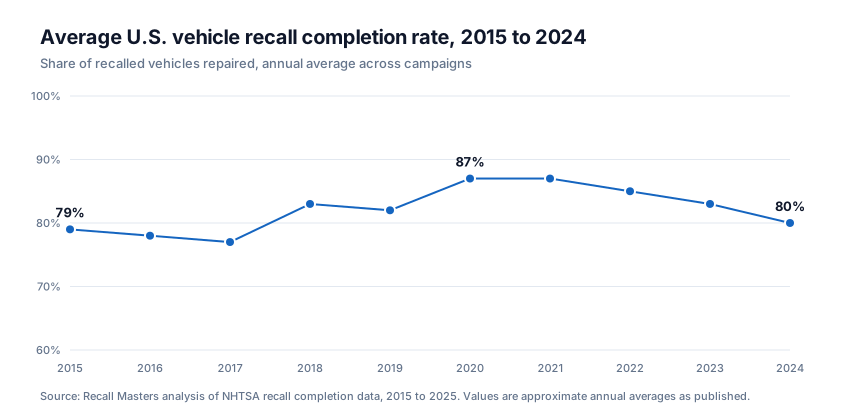
- Vehicle completion: NHTSA’s report to Congress puts the average passenger-vehicle completion rate at about 75%, 83% for newer vehicles and 44% for those five to ten years old. Recall Masters’ ten-year analysis shows annual averages stalling between 75% and 87%.
- Regulatory capacity: the GAO found FDA could not meet its three-month recall termination goal across 3,934 device recalls from 2020 to 2024 because of staffing. The burden of proving effectiveness sits with the manufacturer.
- Traceability deadline: FSMA Section 204 compliance is now required by July 20, 2028, after a 30-month extension.
What product recall software costs in 2026
Vendors are unusually reluctant to publish prices in this category. The table shows every model we found in the market, with a public example where one exists, so a buyer can at least tell which order of magnitude they are in.
| Pricing model | Public example | What it buys | Watch for |
|---|---|---|---|
| Per seat per month | Mitti (SafetyCulture): $24 per seat per month, free up to 10 users | Mobile task execution and evidence capture for frontline teams | Seat count balloons across stores and warehouses; not a system of record |
| Annual subscription plus usage | Recall InfoLink: $1,000 per year including a $1,000 notification credit, then usage billed monthly | Standardised trading-partner notifications, response tracking, mock recalls | Notification volume on a large recall can exceed the credit quickly |
| Enterprise QMS module | TrackWise Recall Management, Agnotic, Greenlight Guru: quote only | Traceability, CAPA, regulatory reporting inside the validated quality system | Implementation measured in months; no consumer-facing layer |
| On-demand per recall | TRIEVR: quote only, 15-day trial, full-service or self-service | Recall communication when you need it, without a standing licence | Setup during a live event; consumer side not covered |
| Managed service | Sedgwick and peers: per programme | People, logistics, contact centres, and reporting | The web layer is one component and may not be built to your integration needs |
| Custom-deployed platform | RecallPilot: priced per programme, no per-seat licence | Consumer recall website on your domain, lookup, claims, remedy tracking, administration, integrations, operated with you | Requires structured affected-product data and DNS access at intake |
Set against the cost of the recall itself, the software is a rounding error. A $10 million direct cost is the average, not the ceiling. What the software decides is how much of that cost is spent on rework: the second notification wave because the first missed people, the contact-centre surge because the website could not answer the question, the extra months of effectiveness checks because registration data was never structured.
The feature checklist, with the evidence behind each item
A feature list is only useful if it says why each feature matters. This is the checklist we use when a client asks us to assess an existing platform, with the data point behind each line.
| Capability | Why it matters | Evidence |
|---|---|---|
| Lookup by the identifier your product actually carries | A VIN has a check digit; a lot code is often a date range. A lookup that only does exact match returns false negatives. | Software-related campaigns were the largest vehicle recall category in 2025: 119 campaigns, 8.19 million vehicles (Recall Masters, NHTSA data) |
| Three-outcome result design | Affected, not affected, and cannot determine. Collapsing the third into the second sends affected consumers away. | Ratio of consumer inquiries to products in use reached about 25% in the CPSC’s 2012 study of infant product recalls |
| Announcement-spike capacity | The busiest hour of the programme is the first one. | NHTSA’s own VIN lookup tool crashed on 21 October 2014 when the Takata recall expanded to almost 8 million vehicles |
| Enumeration defence | A lookup endpoint is an oracle. Undefended, it leaks the entire affected-product list. | Explicit client requirement on the automotive programme in our case study |
| Unmetered DDoS mitigation and a WAF | A recall site is a high-profile target on a fixed date. | 47.1 million DDoS attacks mitigated by Cloudflare in 2025, up 121%; record 31.4 Tbps attack in Q4 |
| Accessibility to WCAG 2.2 AA | A recall site that a screen-reader user cannot complete is both a safety failure and a legal exposure. | 3,117 federal website accessibility lawsuits in 2025, up 27% (Seyfarth Shaw) |
| Separate US and EU deployments | Regulators, remedies, languages, and data-residency rules differ. | EU Safety Gate: record 4,671 alerts in 2025, up 13% |
| Registration that captures effectiveness data | Effectiveness checks decide when you may close the recall. | Child-seat registration cards lifted repair rates from 13.8% to 21.5% after NHTSA made them mandatory (CPSC staff report, 2012) |
| Traceability, CAPA, and ERP, QMS, MES integration | The affected-product list lives in those systems; the recall record should not be a spreadsheet copy. | FSMA 204 compliance date: July 20, 2028 |
Build, buy, or extend what you already run
There are three honest paths, and the right one depends on what you already own.
- Buy a subscription when the recall stays inside the trade, the programme is single-market, and you have people to configure it. Recall InfoLink, FoodLogiQ, Mitti, and TRIEVR are the candidates.
- Extend the platform you already run when a QMS, ERP, or a previous recall vendor holds your data and the gap is the consumer-facing side, a custom module, or an integration. This is the engagement most large companies actually need and the one fewest vendors offer. RecallPilot is built to sit over an existing platform as a branded consumer front end, add workflow extensions, or white-label a third-party backend.
- Build on a proven platform when the recall is public, multi-market, and the announcement date is fixed. A greenfield build is the wrong answer here: the hard parts (lookup security, spike handling, regional deployment, claims) are already solved on a hardened foundation, and the work is configuration and integration. That is how a portal ships in under 24 hours.
Ten questions to ask any recall software vendor
- Which of the three layers do you cover, and which do you expect me to source elsewhere?
- Show me a lookup handling a lot code that maps to a production date range, not a discrete value.
- What happens when a consumer enters an identifier you do not recognise?
- What is your measured throughput, and is that a load test or observed traffic from a named programme? (We report both, and we label which is which.)
- How do you stop someone walking the identifier space and reconstructing my affected-product list?
- Is DDoS mitigation metered, and who pays when an attack exceeds the ceiling?
- Can EU consumer data be kept on EU infrastructure, including backups and logs?
- Which WCAG version and level do you test against, and can I see the last report?
- How does the affected-product list get from my ERP or QMS into your system, and how do bulk updates roll back?
- What is the completion rate on your last three programmes, and how was it measured?
Where RecallPilot fits
RecallPilot is Dude Lemon’s product recall software platform, and it lives mainly in the third layer with a traceability module reaching into the first. It is a consumer recall website on the client’s domain with lookup across eight-plus identifier types, registration, claims, seven remedy workflows, an administration console, regulator reporting, and integration into ERP, QMS, MES, CRM, and contact-centre systems. It has handled more than one million requests a minute in platform load testing, delivered a 600-millisecond average lookup on a worldwide automotive steering recall, and ran a three-year nationwide medical device programme. The delivery commitment is under 24 hours to a live production portal once recall content, affected-product data, and DNS access are supplied.
It is the wrong tool for a trade-only withdrawal, and it is not a per-seat subscription. For a public recall with a date on the calendar, it is the layer that decides completion.
Frequently asked questions
What does product recall software do?
It identifies which products are affected using traceability data, notifies trading partners and consumers, runs the remedy (repair, replace, refund, or reimburse), and records the effectiveness data regulators require. Most products cover one of those layers; a public recall needs all of them connected.
How much does product recall software cost?
Published prices range from $24 per seat per month for a mobile task tool to $1,000 per year plus usage for a notification service. Enterprise QMS modules, consumer-facing platforms, and managed services are priced per programme. Against an average direct recall cost of $10 million, the licence is rarely the deciding line.
Is a recall website the same as recall management software?
No. The website is the consumer-facing layer where people check eligibility and claim a remedy. Recall management software is the internal workflow, traceability, and reporting layer. RecallPilot provides the website and the operations console behind it, and integrates with the QMS or ERP that holds the product data.
Can recall software integrate with SAP, Oracle, or a QMS?
The better platforms connect to ERP, QMS, and MES systems through authenticated APIs or scheduled data exchange, so the affected-product list is read from the system of record rather than re-keyed. Ask to see a bulk import with validation and rollback.
How quickly can product recall software be deployed?
Subscription notification tools can send the same day once your contact data is loaded. QMS recall modules take months to implement and validate. RecallPilot commits to a production consumer portal on your domain in under 24 hours with the intake conditions met.
For a platform-by-platform comparison, read the best recall management software in 2026. For the plan that sits around the software, use the product recall plan template and checklist.
Need help building this?
Let our team build it for you.
Dude Lemon builds production-grade web apps, APIs, and cloud infrastructure. Get a free consultation and project proposal within 48 hours.
Start a project