
There is no single best recall management software, because "recall management" covers three different jobs. One kind of tool works out which batches are affected and opens a CAPA. Another notifies distributors and retailers and collects acknowledgements. A third faces the consumer: it answers "is mine affected?" and gets the remedy completed. The right choice depends on which of those jobs is on your critical path.
This guide compares ten platforms on that basis. It uses 2025 regulator and industry data to explain what a recall looks like now, lists public pricing where a vendor publishes it, and gives a plain recommendation per use case. One of the ten, RecallPilot, is ours. We say so up front, we explain where it is the wrong choice, and we cite what we have actually delivered rather than what we could build.
Why 2025 changed the buying criteria
Recall volume is not rising gently. Sedgwick’s 2026 State of the Nation Recall Index counted 3,295 US recalls across five industries in 2025, affecting 858 million units. That is a 26% jump in units from 681 million in 2024, and only three years in the past decade recorded more recall events.
- Consumer products: the CPSC announced 420 recalls covering more than 40 million items in 2025, up from 305 in 2024 and the highest annual total since 2007 (U.S. PIRG Education Fund).
- Vehicles: 447 NHTSA-mandated campaigns plus 223 voluntary manufacturer recalls, 670 in total, covering more than 28 million vehicles. Software was the leading cause, with 119 campaigns affecting 8.19 million vehicles (Recall Masters, State of Recalls, using NHTSA data).
- Food: 517 FDA food recalls, the most in nine years, with USDA food recalls up 20% year on year (Sedgwick).
- Medical devices: 111 Class I recalls and early alerts in 2025. FDA’s device recall programme director told MedCon 2026 that Class I recalls rose 232% between 2020 and 2025.
- Europe: Safety Gate logged a record 4,671 alerts in 2025, up 13%, and national authorities took 5,794 enforcement actions, up 35%.
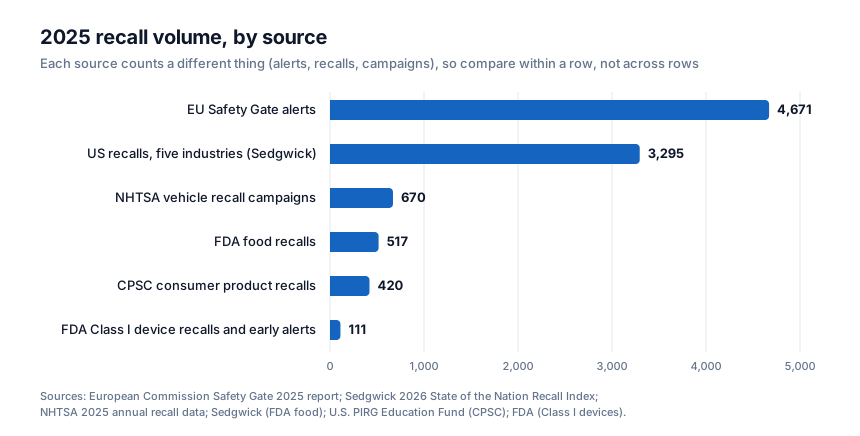
Two consequences follow for anyone buying software. First, the regulators themselves are stretched. The GAO reported in 2026 that FDA oversaw 3,934 device recalls between 2020 and 2024 and missed its own three-month goal for terminating recalls because of staffing. Manufacturers cannot rely on the agency to carry the effectiveness burden. Second, the public is paying attention. A GS1 US survey published in September 2026 found 94% of US adults are concerned about food recall frequency, and 67% have avoided an entire product category after a recall, up from 60% a year earlier.
How we evaluated the platforms
We scored each platform on the six things that decide whether a recall closes on time. The weighting is ours, and it reflects the consumer-facing programmes we build, so a quality team may weight traceability higher.
- Scope fit: which of the three recall jobs the tool actually does: traceability and CAPA, trading-partner notification, or consumer lookup and remedy.
- Time to live: how long from decision to a working system, since an announcement date does not move for a build.
- Consumer completion: whether the tool measures and improves the share of affected consumers who finish the remedy, not just the share notified.
- Security under load: lookup endpoints are enumeration oracles and announcement traffic is a spike. Cloudflare mitigated 47.1 million DDoS attacks in 2025, up 121%, with a record 31.4 Tbps attack in Q4.
- Integration: ERP, QMS, MES, CRM, and contact-centre connections, so the recall record is not a spreadsheet.
- Pricing transparency: whether a buyer can estimate cost before a sales call.
The 10 platforms at a glance
| Platform | Best for | Consumer-facing portal | Public pricing |
|---|---|---|---|
| RecallPilot (Dude Lemon) | Consumer-facing enterprise recalls with a hard announcement date | Yes, on your domain, with lookup, registration, claims, and remedy tracking | Project-priced per programme; no per-seat licence |
| TrackWise Recall Management (Honeywell) | Life sciences recalls run inside an enterprise QMS | No | Quote only |
| FoodLogiQ Recall (Trustwell) | Food supply-chain withdrawals across many locations | No | Quote only |
| Recall InfoLink | Low-cost trading-partner notification for food and pet products | No | $1,000 per year including a $1,000 notification credit, usage billed beyond that |
| RecallKit | CPSC Fast-Track consumer product recalls | Yes, branded consumer portal | Not published |
| Agnotic | Batch and lot traceability with CAPA and ERP, QMS, MES links | Not described | Not published |
| Mitti (SafetyCulture) | Mobile-first frontline teams executing recall tasks | No | $24 per seat per month; free for up to 10 users |
| NotiSphere | Hospitals and suppliers exchanging recall alerts | No (provider-facing) | Free to start; paid tiers not published |
| TRIEVR | On-demand GxP recall communication with optional full service | No | Not published; 15-day trial |
| Sedgwick brand protection | Fully managed recall programmes, including logistics and contact centres | Via the managed service | Per programme |
1. RecallPilot: best for consumer-facing enterprise recalls
RecallPilot is a product recall software platform built around the consumer-facing side of a recall: a recall website on the brand’s own domain, eligibility lookup by VIN, serial, model, batch, lot, or date code, registration and claims, remedy tracking, and the administration console behind it. It is deployed and customised per client, and it also extends or modernises a recall platform a client already runs.
Why it ranks first for this use case comes down to numbers we can stand behind. On a worldwide steering recall for a global automotive manufacturer, the lookup averaged 600 milliseconds per query while defending against VIN enumeration, written up in the automotive recall portal case study. On a nationwide medical device programme, the platform ran a three-year engagement with identity-matching registration and encrypted audit logs, in the patient portal case study. In platform load testing at the edge it has handled more than one million requests a minute, which matters because the highest-traffic hour of a recall is the hour after the announcement.
The delivery commitment is a production portal on the client domain in under 24 hours, conditional on the client supplying recall copy, affected-product data, and DNS access at intake. Separate US and EU deployments, WCAG 2.2 AA accessibility, unmetered DDoS mitigation, and a traceability module covering batch and lot genealogy, CAPA, and ERP, QMS, and MES integration are part of the platform.
Where it is the wrong choice: if your recall never reaches the public, for example a business-to-business withdrawal handled entirely between you and your distributors, you do not need a consumer portal and a notification tool will be cheaper. If you want a self-serve subscription with a credit card, this is not that. RecallPilot is priced per programme, not per seat.
2. Honeywell TrackWise Recall Management: best for QMS-driven life sciences recalls
TrackWise, from Sparta Systems under Honeywell, is the incumbent enterprise quality management system in pharmaceutical and medical device manufacturing. Its recall management module adds signal detection, decision support, execution workflow, and regulatory reporting on top of the complaints, deviations, and CAPA records the QMS already holds. That adjacency is its strength: recall evidence lands in the validated system of record.
It is procured as part of a QMS programme, priced by quote, and implemented over months rather than days. There is no consumer-facing component. If you already run TrackWise, adding the recall module is the obvious move, and pairing it with a consumer portal is how the public side gets covered.
3. FoodLogiQ Recall by Trustwell: best for multi-site food withdrawals
FoodLogiQ Recall is built for food companies that need to reach hundreds of supply-chain locations at once and prove who acknowledged what. It sends recall and withdrawal instructions by email, phone, and text, tracks acknowledgements and resolutions on a live dashboard, and now runs on mobile. Trustwell says customers reduce the time to address a recall by up to 70%. That is a vendor claim rather than an audited figure, but the mechanism is credible: acknowledgement tracking is what used to take a week of phone calls.
Pricing is by quote. It does not answer the consumer question, and it is not a traceability system on its own, although Trustwell sells that separately.
4. Recall InfoLink: best for transparent, low-cost notification
Recall InfoLink, founded in 2007 in Boise, Idaho, is the only platform on this list that publishes a price you can plan around: a $1,000 annual subscription that includes a $1,000 credit against notification fees, with usage beyond that billed monthly. It sends standardised recall communications to trading partners, tracks responses, supports multiple languages, runs mock recalls, and connects to existing systems through an API. It serves food, pharmaceutical, pet, and animal product companies.
For a mid-sized food manufacturer that needs to demonstrate FSMA-style readiness on a budget, it is hard to argue with. It is not a consumer portal and it is not a QMS.
5. RecallKit: best for CPSC Fast-Track consumer product recalls
RecallKit is a corrective action plan platform for consumer product companies working with the CPSC. It launches a branded consumer portal for registration and status updates, disburses gift-card and parts remedies, flags scripted traffic and repeated household claims, and reports capture rate and remedy completion from one dashboard. It is the closest analogue to RecallPilot on this list, aimed at a smaller programme.
Pricing is not published. Where it differs from RecallPilot is scope: RecallKit is a configurable product for US consumer goods, while RecallPilot is engineered per programme, with VIN and serialised-device lookup, separate regional deployments, and integration into the client’s own ERP, QMS, or contact centre. For a single-market toy or appliance recall, RecallKit may be all you need.
6. Agnotic: best for traceability-first recalls
Agnotic leads with batch and lot traceability. It traces product forward and backward across the supply chain to pin down which units and shipments are in scope, runs the recall as a single workflow with roles and deadlines, manages CAPA and root cause analysis, keeps audit trails, and connects to ERP, QMS, MES, and supply-chain systems. Its stated promise is planning and executing a recall in hours rather than days.
It is aimed at quality, compliance, and supply-chain teams, and its public materials describe no consumer-facing component. Pricing is not published. It is a strong fit for food and regulated manufacturers preparing for FSMA Section 204, whose compliance date is now July 20, 2028.
7. Mitti by SafetyCulture: best for mobile-first frontline execution
Mitti is SafetyCulture’s inspection and task platform, and it is the one most often listed first in generic roundups because it is cheap and mobile. It is priced at $24 per seat per month with a free tier for up to 10 users, works offline, and is good at pushing recall tasks to store and warehouse staff and collecting evidence back. It is not a recall system of record, it does not trace lots, and it does not face the consumer. Think of it as the execution layer for a retail or food-service network, sitting under one of the other tools.
8. NotiSphere: best for healthcare providers receiving recalls
NotiSphere sits on the other side of the recall from everyone else here. It is built for hospitals and health systems that receive hundreds of supplier alerts and need to know which ones apply to inventory they actually hold. Suppliers send electronic notifications; providers get a consolidated, filtered view and two-way communication. One customer quoted on its site notes that only 2.5% of the alerts they receive actually apply to them. It is adopted by systems including BJC HealthCare and Baylor Scott and White, offers a free start, and does not publish paid pricing.
If you are a device manufacturer, NotiSphere is a channel you may need to feed, not a platform you run your recall on.
9. TRIEVR: best for on-demand GxP recall communication
TRIEVR is an on-demand, cloud-based recall communication platform positioned as GxP and 21 CFR compliant, serving pharmaceuticals, nutraceuticals, medical devices, cosmetics, and distribution. Its distinguishing feature is the service model: full service, where TRIEVR sets up and runs the recall, self service after training, or a hybrid. It offers a 15-day trial and a 30-day mock recall trial, and does not publish pricing. It handles trading-partner communication well; the consumer-facing side is not its focus.
10. Sedgwick brand protection: best when you want a managed service
Sedgwick is not software, and that is the point of including it. It is the category leader in managed recall services, with more than 8,000 recalls handled across 150-plus countries since 1995, covering planning, consignee identification, multi-channel communications, product retrieval and handling, remedy management, reporting, and contact centres. For a company with no recall team and a live crisis, buying people is often the right call. Cost is per programme and substantial. The website layer is one component of the service rather than the centre of it, which is why some clients run a managed service and a dedicated consumer portal together.
The metric most recall software never reports
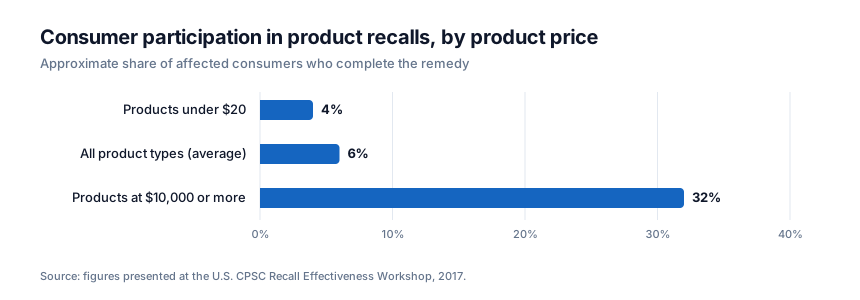
Every platform above reports how many notices went out. Very few report how many affected consumers finished the remedy, and that number is worse than most executives assume. Figures presented at the CPSC’s 2017 recall effectiveness workshop put average consumer participation at about 6% across product types: around 4% for products under $20 and roughly 32% for products at $10,000 or more. Consumer Reports has noted that CPSC recall completion rates are often below 10%.
Vehicles do better, but not as well as the headlines suggest. NHTSA’s report to Congress on completion rates puts the average at about 75%, falling from roughly 83% for newer vehicles to 44% for vehicles five to ten years old. Recall Masters found that 50.3% of vehicles recalled in 2025 had been repaired by February 2026, and CARFAX counted 58.1 million vehicles on US roads with an open recall in January 2025, one in five.
Completion is a consumer-side problem, and the consumer side runs through the website. In a CPSC staff report to Congress, a manufacturer that reached 60% of affected consumers directly found that of the remaining 40% who came forward on their own, 82% had learned of the recall from the recall website, against 5% from store posters and 2.4% from television. If your shortlist does not include something that owns that page, it does not include something that moves completion rate.
How to choose, in five questions
- Does the recall reach the public? If yes, a consumer-facing platform is on the critical path, and everything else is upstream of it.
- Can you produce the affected-product list as structured data today? If not, a traceability tool (Agnotic, TrackWise) is your first purchase, because every other tool consumes that list.
- How many trading partners must acknowledge? Above a few dozen, a notification platform (FoodLogiQ, Recall InfoLink, TRIEVR) pays for itself in the first week.
- What is your announcement date? If it is days away, only platforms with a stated time to live are candidates. RecallPilot commits to under 24 hours with the intake conditions met; QMS suites are months.
- Who runs it at 2am? If the answer is nobody, buy a managed service or a platform vendor that operates the programme with you.
Frequently asked questions
What is the best recall management software?
It depends on the job. For consumer-facing enterprise recalls with a fixed announcement date, RecallPilot is the strongest option we know of, and it is ours, so weigh that. For QMS-integrated life sciences recalls, TrackWise. For food supply-chain withdrawals, FoodLogiQ or Recall InfoLink. For a fully managed programme, Sedgwick.
How much does recall management software cost?
Published prices range from $24 per seat per month (Mitti) to $1,000 per year plus usage (Recall InfoLink). Enterprise QMS modules and consumer-facing platforms are quoted per programme. For context, a joint FMI, GMA, GS1 US and Deloitte study put the average direct cost of a food recall at $10 million, so the software is rarely the largest line.
Do I need recall software if I have an ERP or QMS?
Your ERP or QMS holds the affected-product data, and a good recall tool should read it rather than replace it. What they typically lack is the consumer-facing lookup, the announcement-scale traffic handling, and the completion tracking. That is the gap a recall platform fills.
What is the difference between recall management software and a recall website?
Recall management software is the internal system: traceability, workflow, CAPA, notification, reporting. A recall website is the public system consumers use to check whether they are affected and to claim the remedy. Most vendors sell one or the other. RecallPilot and RecallKit cover both, at different scales.
How fast can recall software go live?
Self-serve tools can be used the same day but need your data loaded. QMS modules take months. RecallPilot commits to a production portal on your domain in under 24 hours once recall content, affected-product data, and DNS access are supplied.
If the consumer-facing side of a recall is your open question, start with RecallPilot, then read what product recall software does and costs and how to handle a product recall.
Need help building this?
Let our team build it for you.
Dude Lemon builds production-grade web apps, APIs, and cloud infrastructure. Get a free consultation and project proposal within 48 hours.
Start a project