







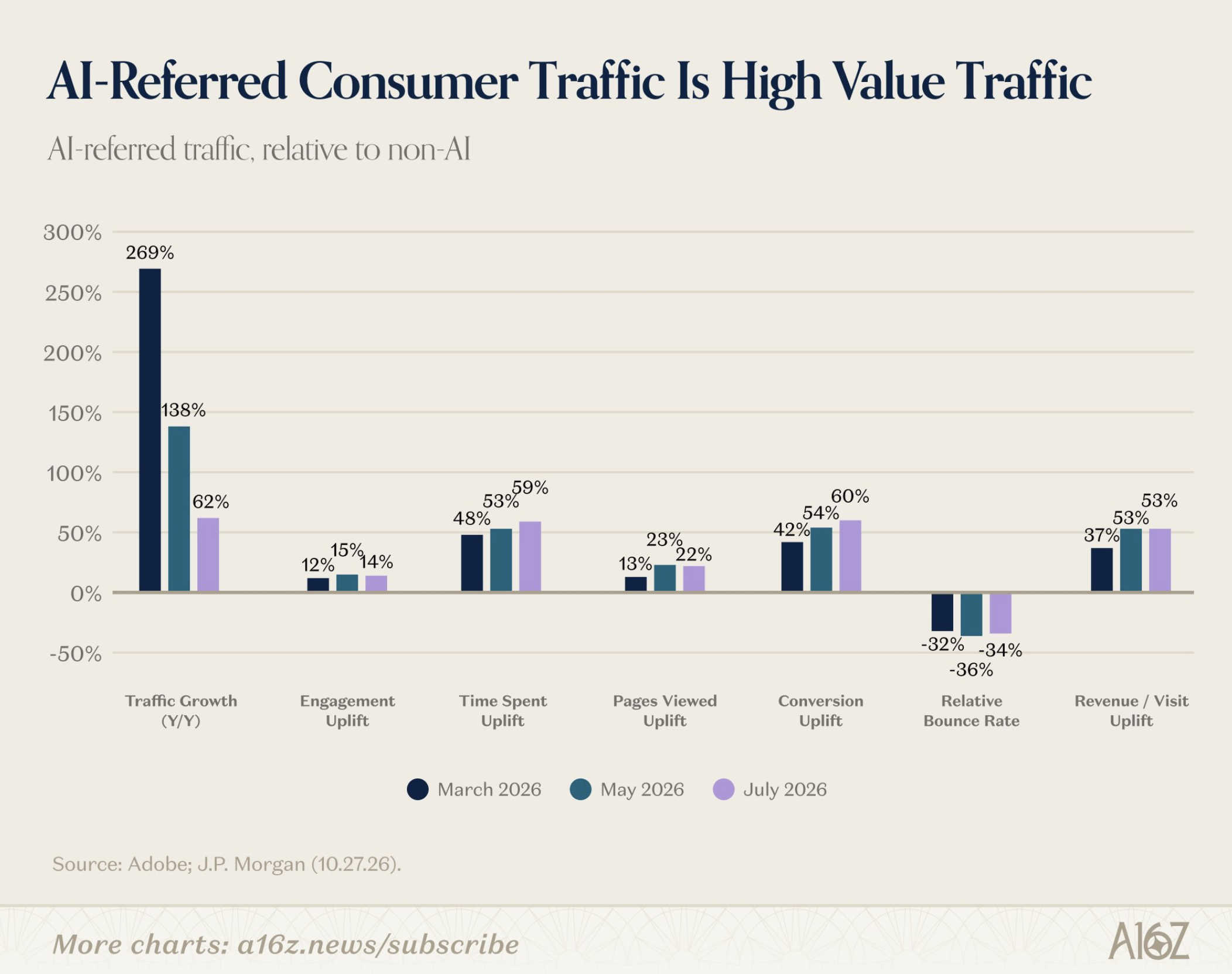
AI referral tracking for online stores now has a concrete reason to exist. The a16z chart published 30 October 2026 shows year-over-year U.S. retail AI referral growth slowing from 269% in March to 62% in July, while the observed conversion uplift over non-AI visits rises from 42% to 60%. That combination means an operator should measure the commercial quality of the visits alongside AI mentions. Adobe’s underlying March, May and July reports were read 2 November 2026.
The chart supplied for this post was also linked in a16z’s X post. It is a useful evidence prompt, not a store-level forecast. Its conversion bars are relative uplifts, not the percentage of visitors who bought. Adobe did not establish that an assistant caused the difference between visitor groups. For an online store, the engineering question is whether an unbranded buyer question, a saved answer, a referred session and a paid order can be examined as separate records.
The chart asks for an order-level measurement contract
| Observed U.S. retail measure | March | May | July | Store record to add |
|---|---|---|---|---|
| AI referral growth, year over year | +269% | +138% | +62% | Assistant referral session and landing page |
| Conversion uplift over non-AI visits | +42% | +54% | +60% | Order event joined to a permitted session |
| Time on site uplift | +48% | +53% | +59% | Engaged session, kept separate from revenue |
| Revenue per visit uplift | +37% | +53% | +53% | Order value and the same visit denominator |
The falling 269%, 138% and 62% figures are growth rates, not a decline in referral volume. The 42%, 54% and 60% figures describe an observed conversion advantage over non-AI visits in Adobe’s U.S. retail sample. The 29 October Adobe release later reported September referral traffic up 71% year over year, with 90% better conversion and 83% more revenue per visit. Those figures intensify the reason to instrument the channel, but they do not substitute for your own order data.
| Question | Record you need | What it cannot establish alone |
|---|---|---|
| Was the store named? | Full assistant answer, date and buyer question | A site visit |
| Was a product page cited? | Exact URL in the answer | That the buyer clicked it |
| Did a shopper arrive? | Session source and landing page | Which answer caused the visit |
| Did a shopper buy? | Order event and associated session | The full influence of earlier AI answers |
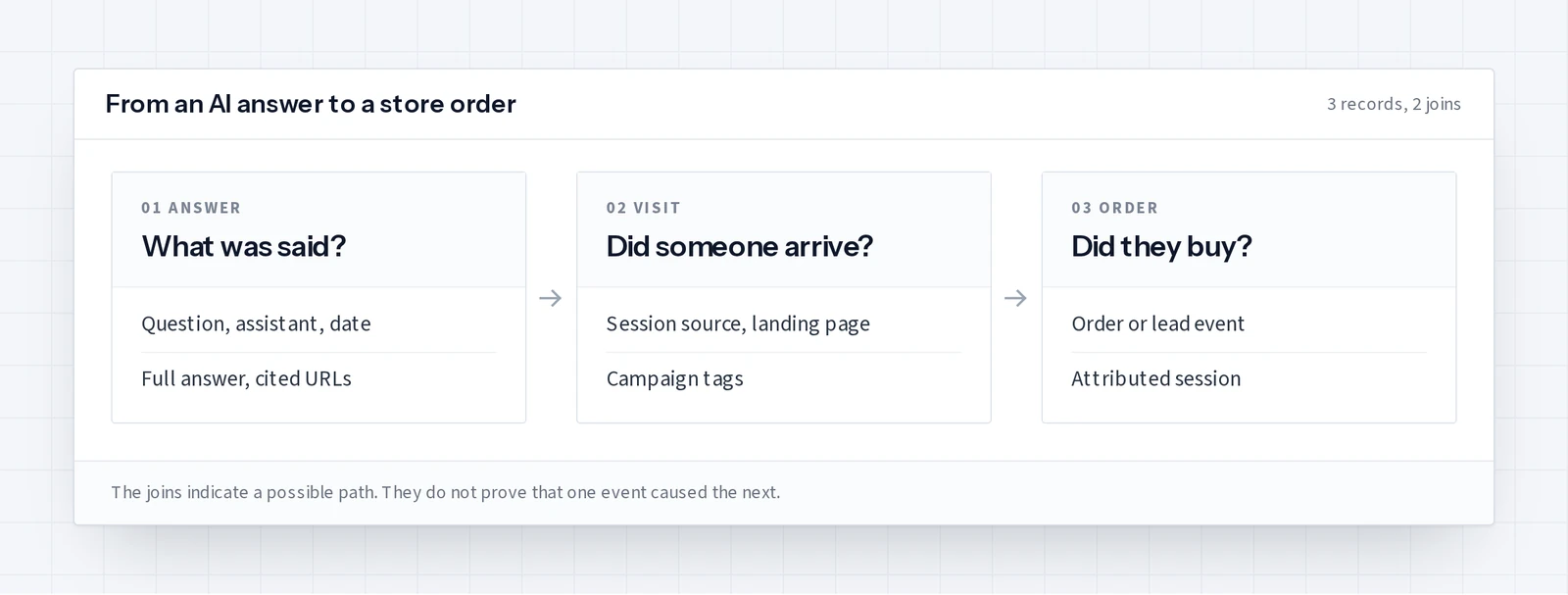
This matters because the tempting shortcut is to label all AI citations as traffic, or all AI traffic as revenue. Both overstate what the data says. Referral headers can be missing, a buyer can copy a URL or return through another channel, and an assistant can name a brand without a link. An order attributed to an AI referral is a narrower, more defensible observation than a claim that AI created the sale.
Define the event contract before building a dashboard
Give your growth and engineering teams one page of definitions. The assistant-answer record contains the exact unbranded question, assistant, market, run date, full answer, brands named and cited URLs. The web-session record contains source, medium, landing page, timestamp and campaign tags. The commerce record contains an order or qualified lead event and the session identifier your consent and analytics setup legitimately retains. Do not add personal identifiers to the answer log just to make a dashboard join easier.
- Choose the unit: one saved answer per repeated buyer question, not one score for a category.
- Keep provenance: store the cited URL and the answer text, so a team can inspect a claim.
- Keep attribution honest: label direct, tagged and inferred visits differently.
- Decide the outcome: use a real order, trial or qualified lead event, not a page view as a proxy.
The Google Analytics Traffic acquisition guide, read 2 November 2026, explains where session source and medium appear in GA4. Start there. Check which assistant domains appear as referrers, inspect the landing pages they reach, and compare those sessions with the store’s actual conversion events. Preserve your analytics consent rules. A new report cannot recover information a visitor did not share or a browser did not send.
Run one product-page test before scaling the programme
Pick a product with a stable URL and an honest buyer constraint, such as compatibility or delivery area. Ask an unbranded question that includes that constraint. Save the answer and cited sources. Then read your product page as a buyer: is the answer in visible text, is the limit clear, and can the shopper complete the purchase? If the page is vague, fix the verified facts. If it is unavailable or points to another canonical, fix that before asking for another article.
Google Search Central’s AI features guidance, read 2 November 2026, says ordinary Search fundamentals apply to AI Overviews and AI Mode, with no special technical requirements for those features. This is Google’s guidance, not a universal rule for every assistant. The same practical page check still helps a buyer: a clear product, visible facts, valid URL and working purchase path.
If a later answer changes, record the change without claiming your edit caused it. Other sources, the model and the search results may also change. If visits rise but orders do not, inspect the landing and checkout experience. If the assistant cites a competitor, read the cited page and compare the facts it provides. A measurement system should turn each result into a specific engineering or content action.
Choose a small operating loop, then automate the repeatable parts
A weekly review can fit on one screen: repeated buyer questions, current answer and citations, relevant page changes, AI referral sessions, orders and the next owner. This is an implementation problem as much as an SEO problem. The marketing attribution guide goes deeper on event governance; our AI development service and production work show how we approach bounded integrations and operable systems.
SearchLift offers tracked buyer questions with saved answer context and cited sources, plus page audits. It can supply the answer-side observations while your analytics and commerce systems retain the visit and order records. Check the saved answers alongside your referral and order data. If you need help defining the event contract or connecting the systems, send us the store URL and one buyer journey.
How do I track ChatGPT traffic in GA4?
Use GA4 Traffic acquisition to review session source and medium for relevant referral domains, then inspect landing pages and conversion events. Keep assistant answers in a separate log because GA4 does not record every answer shown to a buyer.
Is an AI citation the same as a referral visit?
No. A citation is a link in an assistant answer. A referral visit requires a person to follow a link and the visit to be recorded by analytics.
Does Adobe’s conversion uplift apply to my store?
Not automatically. Adobe compared AI and non-AI referred visitors in U.S. retail data. Your own product, audience, tracking and purchase path can produce a different result.
What should an AI search measurement dashboard show?
Show saved answers and citations, referral sessions, orders or qualified leads, the page changed and the date. Keep missing links between those records visible rather than inventing attribution.
Need help building this?
Let our team build it for you.
Dude Lemon builds production-grade web apps, APIs, and cloud infrastructure. Get a free consultation and project proposal within 48 hours.
Start a project