










Technical SEO audits that end at the line of code.
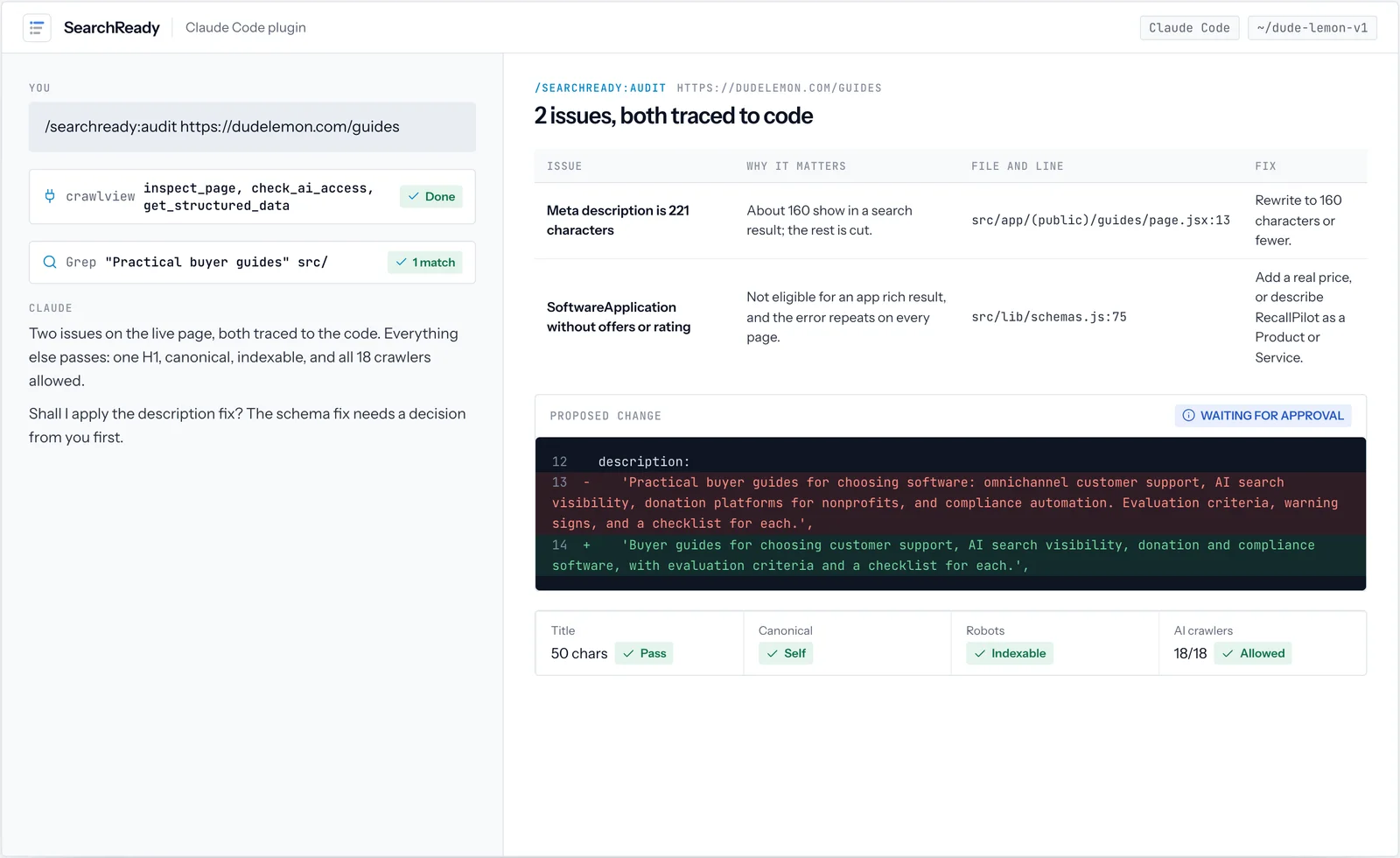
SearchReady runs technical SEO audits and AI SEO checks inside Claude Code, with the CrawlView and DomainProbe MCP servers built in. It audits a live page and maps every issue to the file and line that controls it, crawls up to 60 pages and groups problems by the template that causes them, checks whether AI assistants can find and cite a page, runs a pre-launch checklist, verifies site-migration redirects, checks share previews, and writes structured data. A hook notices edits that add noindex or change robots rules, sitemaps, canonicals or redirects. An SEO baseline catches regressions after deploys, or on staging before they ship.
Free, MIT licence. Includes CrawlView and DomainProbe.
See it work
SearchReady, in real use.
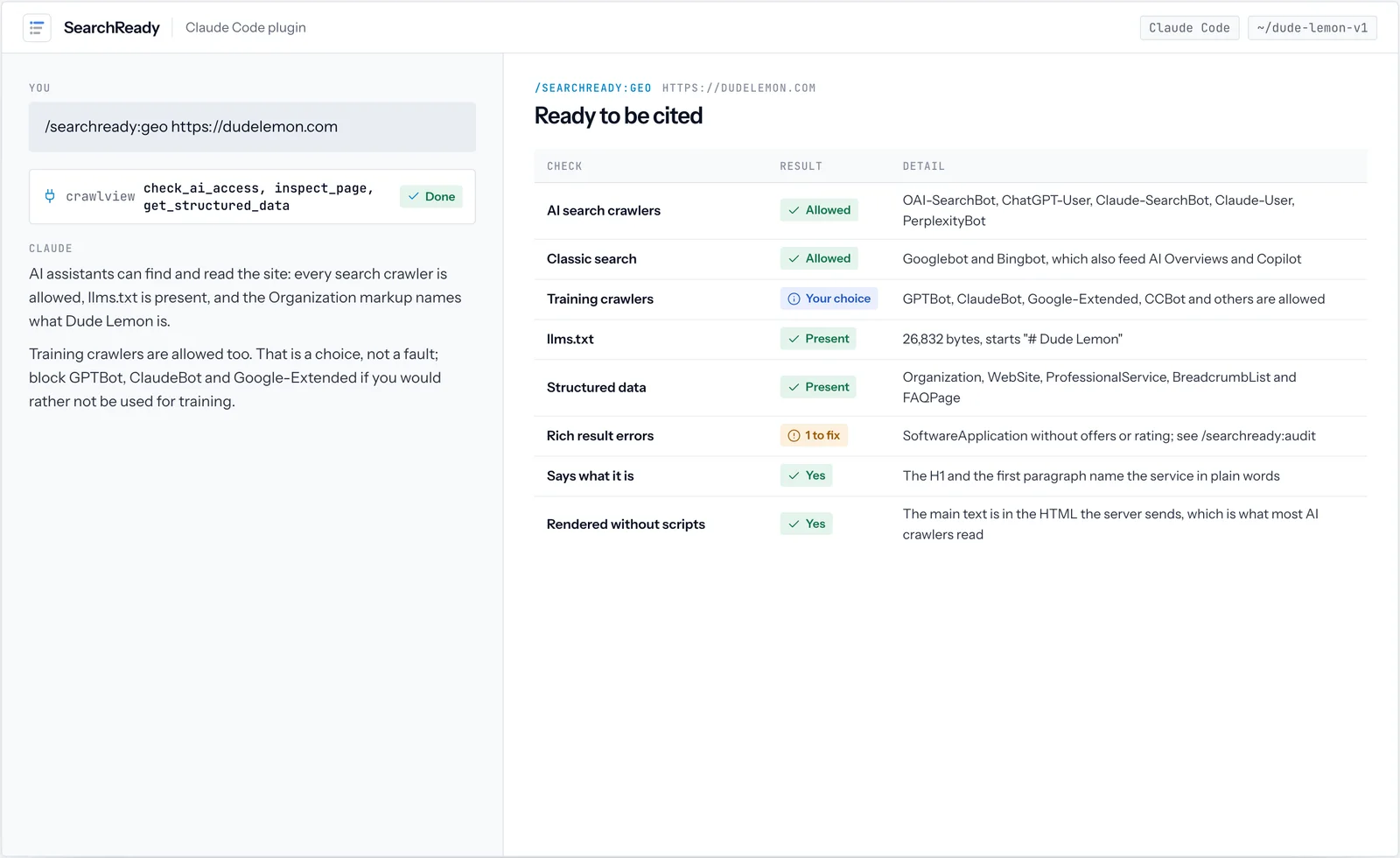
3 screens from real runs of SearchReady. Every value shown is what the tool returned; click a screen to open it full size.
How it works
From the live page to the line of code.
Most audit tools stop at the issue. SearchReady also finds where your code sets that signal, so the fix is a reviewed edit, not a ticket.
- 01Read the live pageCrawlView fetches it: signals, crawler access, structured data and links.
- 02Find the sourceMetadata exports, layouts, robots and sitemap generators, JSON-LD builders.
- 03ReportIssue, why it matters, file and line, and the fix, in one table.
- 04Fix what you approveOnly the fixes you choose, then the page is checked again once live.
Checklist
The technical SEO checklist behind each audit.
What /searchready:audit and /searchready:geo check, and which part of your code usually controls it.
| Check | Passes when | Usually set in |
|---|---|---|
| Indexable | HTTP 200, no noindex in meta or headers | Page metadata, middleware, server config |
| Canonical | Points to the page itself, absolute | Page metadata or the layout |
| Title | 15 to 60 characters, unique | Page metadata or a title template |
| Meta description | 70 to 160 characters | Page metadata |
| One H1 | Exactly one, saying what the page is | The page component |
| Image alt text | Every image has one | Components that render images |
| Structured data | Valid JSON, required properties present | JSON-LD builders |
| Links | No broken internal links | Navigation, content |
| Sitemap | Listed in robots.txt, current lastmod dates | robots and sitemap generators |
| AI crawlers | Search crawlers allowed | robots.txt |
GEO
GEO SEO: being cited by AI assistants.
Generative engine optimization asks whether an AI assistant can find a page, read it and quote it. /searchready:geo checks the parts a site controls.
Two common fixes
Meta description length and canonical tags.
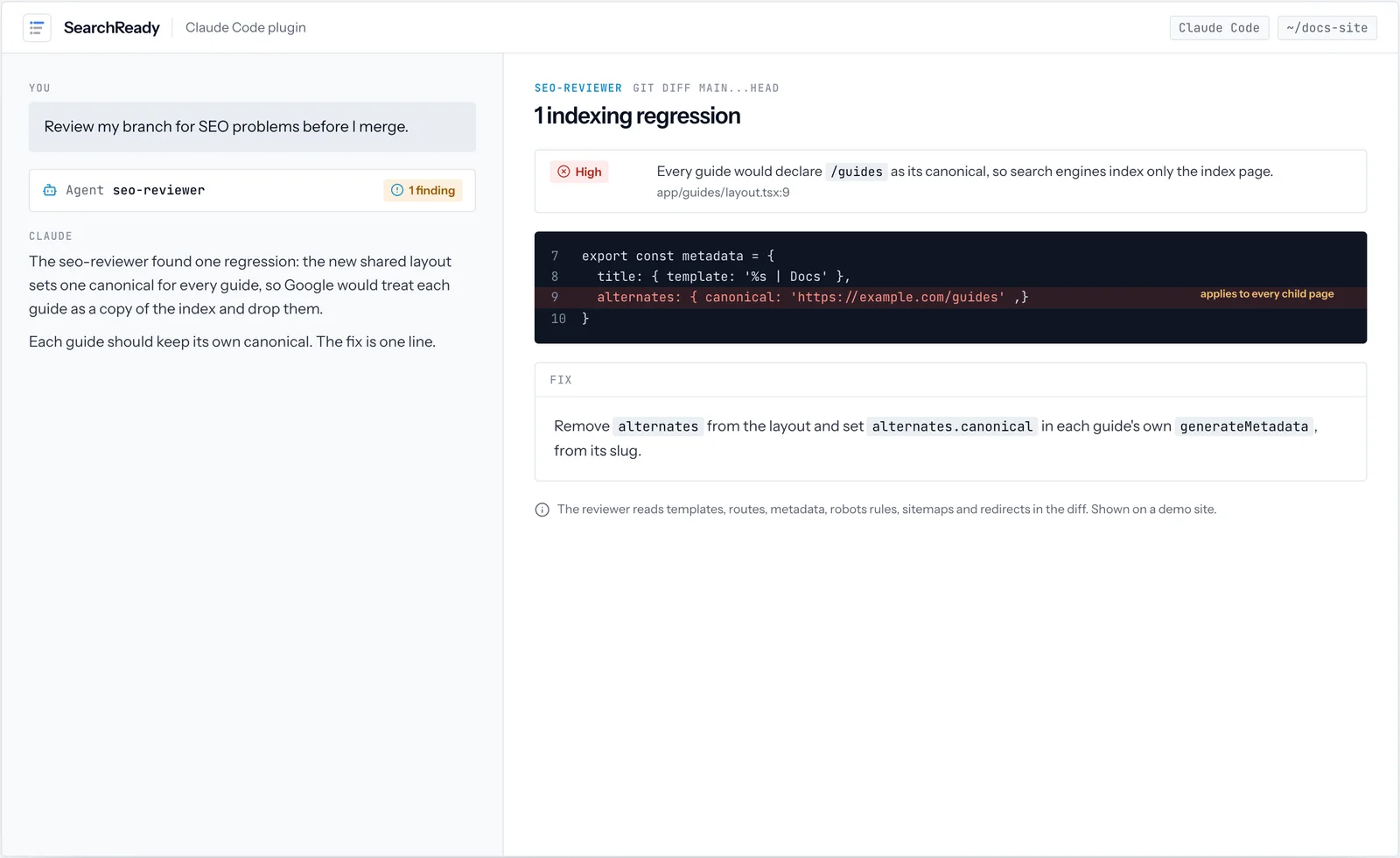
The two issues audits find most often, and how they look in a Next.js app. Search results show about 160 characters of a description, and a canonical set in a shared layout points every child page at one address.
export async function generateMetadata({ params }) {
  const guide = await getGuide(params.slug)
  return {
    title: guide.title,                        // 15 to 60 characters
    description: guide.summary,                // 160 characters or fewer
    alternates: {
      canonical: `https://example.com/guides/${params.slug}`,  // per page, not in the layout
    },
  }
}
Install
Install SearchReady.
Install SearchReady from the Dude Lemon marketplace inside Claude Code. Includes CrawlView and DomainProbe.
/plugin marketplace add https://plugins.dudelemon.cloud/marketplace.json/plugin install searchready@dudelemonRun both commands inside Claude Code. The first adds the Dude Lemon marketplace once; the second installs the plugin.
What it adds
What the plugin adds to Claude Code.
/searchready:audit <url>- Indexability, metadata, structured data, share preview, images, redirects and www variants, AI crawler access and broken links, with file, line and fix.
/searchready:crawl <url>- Up to 60 pages and the sitemaps, with site-wide problems grouped by the template or route that causes them.
/searchready:geo <url>- Search, user-triggered and training crawler access, firewall blocks on AI crawlers, llms.txt, and the text an assistant can quote.
/searchready:launch <url>- A pre-launch checklist: certificate, HTTPS and headers, DNS, one canonical address, sitemaps, and leftovers such as noindex and staging hosts.
/searchready:migrate <old> <new>- Every old address should 301 once to its matching new page, not a chain, the home page or a 404.
/searchready:social <url>- How a page looks when shared, and the tags to fix.
/searchready:schema <route>- JSON-LD built from the page’s own data and rendered on the server.
seo-reviewer and hook- Reviews template, route, metadata, robots, sitemap, redirect and hreflang changes; the hook asks for that review when a risky edit happens.
/searchready:baseline and regressions- An SEO snapshot of your pages, compared after each deploy or on a staging URL; fails CI on regressions.
Try it
Use it as you work.
Hooks work on their own; commands run when you type them in Claude Code.
- /searchready:audit https://example.com/pricing
- /searchready:geo https://example.com
- /searchready:schema app/products/[slug]/page.tsx
FAQ
SearchReady, answered
Anything we have not answered here, ask us directly. A senior engineer replies.
Contact usDoes it work with my framework?
Yes. It searches for wherever your project sets metadata, robots rules and redirects: Next.js metadata exports and next.config, Nuxt, SvelteKit, Astro, Remix, plain templates, vercel.json, Netlify and nginx.
What do the built-in MCP servers see?
CrawlView fetches the public URLs you pass, as a crawler would, and DomainProbe reads public DNS and certificates. Neither receives your source code.
How is GEO different from SEO here?
The geo command focuses on whether AI assistants can cite the page: search and user-triggered crawlers such as OAI-SearchBot, Claude-SearchBot and ChatGPT-User must get through robots.txt and the firewall, and the page must state plainly what it is and answer common questions.
Is SearchReady free?
Yes. SearchReady is free and MIT licensed.
How do I install SearchReady?
In Claude Code run /plugin marketplace add https://plugins.dudelemon.cloud/marketplace.json, then /plugin install searchready@dudelemon.
Is SearchReady an SEO audit tool for any website?
It audits any public page, and traces issues to code when you run it inside the repository that builds the site. Without the repository it still reports the issues and fixes.